Losing a tooth can affect more than your smile. It may change how you chew, speak, and feel about your appearance. When one or more teeth are missing, dental implants are among the treatment options that can help restore function, comfort, and confidence.
But are you better off with a single tooth implant or multiple dental implants? Is the treatment different when you have lost several teeth? Does the number of implants affect healing time, cost, or the final result?
Understanding the difference between single and multiple dental implants can help you make a more informed decision before starting treatment. At Sky Dental Clinic, patients can explore suitable tooth replacement solutions based on their dental condition, bone health, and long-term oral health goals.
What Is a Single Tooth Implant?
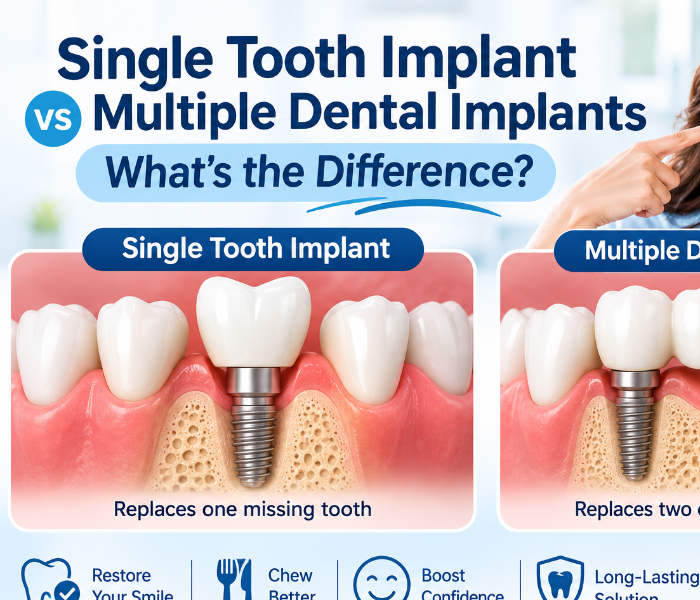
A single tooth implant is used to replace one missing tooth without affecting the neighbouring natural teeth. It consists of a small titanium implant placed into the jawbone, an abutment that connects the implant to the restoration, and a custom-made crown that resembles a natural tooth.
Once the implant integrates with the jawbone, it provides a stable foundation for the replacement tooth.
Single tooth implants are commonly considered when:
-
One tooth is missing due to injury, decay, or extraction.
-
The surrounding teeth are healthy and do not need to be altered.
-
There is sufficient jawbone to support the implant.
-
The patient wants a fixed replacement instead of a removable tooth.
One of the biggest advantages is that the neighbouring teeth usually remain untouched. Unlike traditional bridges, a single implant does not generally require the adjacent teeth to be reshaped to support the restoration.
What Are Multiple Dental Implants?
Multiple dental implants are used when two or more teeth are missing. Depending on the location and number of missing teeth, the treatment may involve placing separate implants or using a few implants to support a larger dental prosthesis.
For example, if three teeth are missing next to each other, a dentist may recommend two implants supporting a three-unit implant bridge rather than placing three individual implants. The final plan depends on bone support, bite forces, spacing, and the overall condition of the mouth.Multiple dental implants may be recommended for:
-
Two or more missing teeth in the same area.
-
Several missing teeth in different parts of the mouth.
-
Patients looking for a fixed alternative to removable partial dentures.
-
Restoring chewing function and supporting the appearance of the smile.
In cases where most or all teeth are missing, implant-supported full-arch restorations may also be considered.
Single Tooth Implant vs Multiple Dental Implants: Key Differences
Although both treatments use the same basic implant technology, the treatment planning and restoration process can be quite different.
|
Feature |
Single Tooth Implant |
Multiple Dental Implants |
|
Purpose |
Replaces one missing tooth |
Replaces two or more missing teeth |
|
Implant placement |
Usually one implant |
One or more implants depending on the case |
|
Restoration |
Individual crown |
Multiple crowns, implant bridge or full-arch prosthesis |
|
Treatment planning |
Focuses on one tooth and surrounding tissues |
Considers spacing, bite, bone support and overall tooth arrangement |
|
Complexity |
Often relatively straightforward |
May require more extensive planning and procedures |
|
Healing |
Depends on bone integration and individual healing |
May vary depending on the number of implants and surgical requirements |
The number of missing teeth does not always equal the number of implants required. A dentist may strategically position implants to support several replacement teeth while maintaining stability and function.
Which Treatment Is More Comfortable?
Many patients worry that multiple implants will be significantly more painful than a single implant. However, discomfort varies depending on the procedure, the patient's health, and the complexity of treatment.
Dental implant placement is usually performed under local anaesthesia. Mild swelling, tenderness, or discomfort can occur afterward and is generally managed with the dentist's instructions and prescribed medication when necessary.
When several implants are placed during one appointment, the treatment may involve a larger surgical area. However, some patients may prefer completing planned implant placements in fewer surgical visits rather than undergoing separate procedures over time.
A proper consultation helps determine whether placing implants together or in stages is more suitable.
Do Multiple Dental Implants Take Longer to Heal?
Healing time is not determined only by the number of implants. Factors such as bone quality, gum health, smoking, medical conditions, and whether bone grafting is required can influence recovery.
The implant needs time to integrate with the jawbone through a process called osseointegration. During this period, the dentist monitors healing before proceeding with the final restoration, when appropriate.
Some patients may receive temporary teeth during treatment, while others may need to wait until the implant site has healed sufficiently.
If you are considering treatment, visiting a Dental clinic in Bangalore for a detailed examination can help you understand the expected timeline and whether additional procedures may be necessary.
What About Cost? Is One Implant More Affordable?
A single tooth implant generally costs less overall than treatment involving multiple implants because fewer implant components and restorations are required.
However, multiple implants do not always mean paying for one implant per missing tooth. Implant bridges and full-arch treatment options may reduce the total number of implants needed, depending on the case.
The cost may also vary based on:
-
The implant system and materials used.
-
Bone grafting or other preparatory procedures.
-
The type of crown or bridge restoration.
-
Diagnostic scans and treatment complexity.
-
Temporary teeth and additional treatment requirements.
Instead of comparing prices alone, patients should understand what is included in the treatment plan and how the proposed restoration is expected to function over time.
How Do You Know Which Option Is Right for You?
The right implant treatment depends on your oral health, not simply the number of missing teeth. A clinical examination, dental imaging, gum assessment, and bite evaluation help determine the appropriate approach.
Whether you need one implant or several, consulting an experienced Top Dentist in Bangalore can help you understand the available options and their benefits and limitations.
Patients looking for a Best Dental clinic in Koramangala can discuss their tooth replacement concerns and receive guidance on suitable implant treatment. Similarly, those searching for a Dental clinic in RR Nagar or a Dental clinic in Yelahanka can explore treatment options based on their individual dental needs.
Restore Your Smile with the Right Dental Implant Solution
A missing tooth should not be ignored simply because it is not causing pain. Over time, gaps can affect chewing, allow neighbouring teeth to shift, and contribute to changes in bite alignment. Replacing missing teeth at the right time may help preserve oral function and make future treatment easier.
At Sky Dental Clinic, dental implant treatment is planned around the patient's needs, existing teeth, bone condition, and desired outcome. Whether you are missing a single tooth or several teeth, understanding your options is the first step towards restoring your smile.
One missing tooth or multiple missing teeth — the goal remains the same: a healthy, functional, and confident smile that feels natural.


 ManyaSoft