Losing a tooth can affect much more than your smile. It can make chewing uncomfortable, change the way you speak, and gradually affect the bone that once supported your natural tooth. Dental implants offer a reliable option for replacing missing teeth, but there is one important factor that determines whether an implant can be placed successfully: the quality and quantity of your jawbone.
What happens if your jawbone is too thin or weak to support an implant? This is where bone grafting may become necessary.
Although the words “bone grafting” may sound intimidating, the procedure is commonly used in implant dentistry to help rebuild areas of insufficient bone. Understanding why it is recommended, how it works, and what recovery involves can help you approach your dental implant journey with greater confidence.
What Is Bone Grafting in Dental Implant Treatment?
A dental implant is a small, screw-shaped post placed in the jawbone to support a replacement tooth. Over time, the implant bonds with the surrounding bone, creating a stable foundation for the artificial tooth.
However, an implant needs sufficient bone around it for proper support. If the jawbone has lost too much height, width, or density, placing an implant directly may not be appropriate.
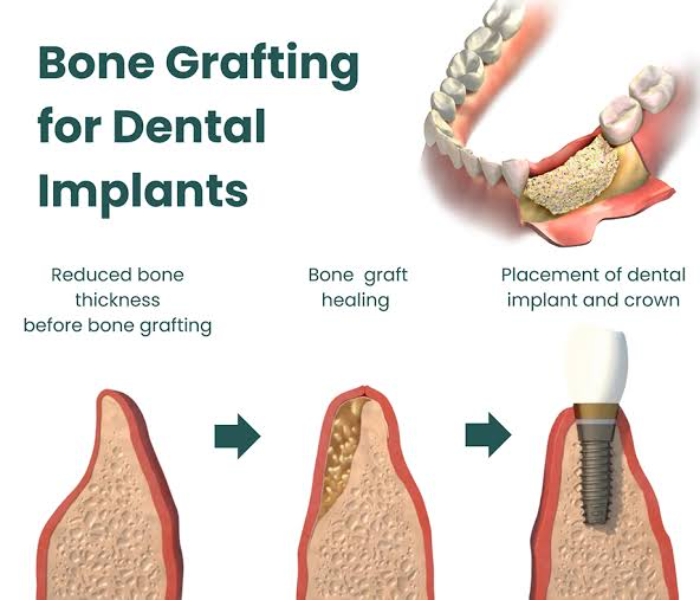
Bone grafting is a procedure that adds bone or a bone-substitute material to an area where additional support is needed. The graft acts as a framework that helps your body develop new bone over time.
According to the American Association of Oral and Maxillofacial Surgeons, bone grafting can help restore the quantity and quality of bone needed for dental implant treatment.
The goal is simple: build a suitable foundation before placing the replacement tooth.
Why Does Jawbone Loss Happen After Losing a Tooth?
Your natural teeth do more than help you chew. Their roots stimulate the surrounding jawbone during everyday activities such as biting and eating.
When a tooth is lost, that stimulation decreases. The bone in the empty space may gradually shrink because it is no longer supporting the natural tooth root.
Several factors can contribute to bone loss:
- Missing teeth for a long time: The jawbone in the empty area may gradually become thinner or shorter.
- Advanced gum disease: Periodontal disease can damage the tissues and bone that support your teeth.
- Severe tooth infections: Infections around a tooth can destroy surrounding bone.
- Dental injuries: Trauma can damage the jawbone and surrounding structures.
- Previous tooth extractions: Some patients experience significant bone changes after an extraction.
This is why a person who lost a tooth several years ago may need additional preparation before receiving a dental implant. However, not everyone with a missing tooth requires bone grafting.
5 Reasons Bone Grafting May Be Necessary Before Dental Implants
1. To Create Enough Bone to Support the Implant
Imagine building a house on an unstable foundation. Even if the house is beautifully designed, its foundation must be strong enough to support the structure.
Dental implants follow a similar principle.
If the jawbone is too narrow or shallow, the implant may not have adequate support. Bone grafting can help rebuild the deficient area so the dentist can plan a more suitable implant placement.
2. To Improve Implant Stability
For an implant to function properly, it must become securely integrated with the surrounding bone. This biological process is known as osseointegration.
Insufficient bone can make it difficult to achieve the required stability. In selected cases, rebuilding the bone can improve the conditions needed for implant placement and healing.
Bone grafting does not guarantee implant success, but it can help address an important limitation in patients with inadequate bone.
3. To Restore Bone Lost Through Gum Disease
Gum disease is not limited to swollen or bleeding gums. In advanced stages, it can damage the bone supporting the teeth.
If a tooth is lost because of severe periodontal disease, the affected area may not have enough healthy bone for an implant.
The dentist must first assess the condition of the gums, control any active infection, and evaluate the remaining bone. Bone grafting may then be considered as part of a personalised treatment plan.
4. To Support a Natural-Looking Smile
Dental implants are designed to restore both function and appearance. However, the surrounding bone also helps support the gum tissue around the replacement tooth.
When significant bone is missing, it can be more challenging to achieve a natural-looking contour, particularly in areas visible when you smile.
Bone grafting may help restore the shape of the jawbone and provide better support for the surrounding tissues. The final aesthetic outcome depends on several factors, including gum health, bone anatomy, implant positioning, and the type of restoration.
5. To Address Bone Loss in the Upper Jaw
Replacing missing upper back teeth can sometimes present an additional challenge because of the nearby maxillary sinus.
If there is insufficient bone between the mouth and the sinus, a specialised procedure called a sinus lift may be recommended. It creates additional space for bone development in the area where the implant is planned.
A sinus lift is one form of bone augmentation, but it is not necessary for every patient receiving an upper-jaw implant.
What Happens During a Bone Grafting Procedure?
The exact procedure depends on how much bone is missing and where the deficiency is located.
Generally, treatment involves the following steps:
Step 1: Examination and planning
The dentist evaluates your oral health and may recommend dental X-rays or a 3D scan to assess the bone's dimensions and nearby anatomical structures.
Step 2: Preparing the area
The treatment area is accessed under appropriate anaesthesia. The dentist prepares the site for the graft material.
Step 3: Placing the graft
Bone graft material is positioned in the area that requires additional support. Depending on the case, a protective membrane may also be used.
Graft materials can come from the patient's own bone, a suitably processed donor source, an animal-derived source, or synthetic materials. The appropriate option depends on clinical requirements and individual circumstances.
Step 4: Healing and bone development
Over the following months, the grafted area heals and new bone develops. The dentist determines when the site is ready for implant placement.
In selected cases, bone grafting and implant placement can be performed during the same appointment. In other situations, the graft must heal before the implant is inserted.
How Long Does Bone Grafting Take to Heal?
Healing time varies according to the size of the graft, the location, the material used, and your overall health.
Some smaller grafts may heal sufficiently within a few months, while larger grafts or more complex procedures can require longer. Your dentist will assess the site before deciding when to proceed with the implant.
During recovery, you may experience swelling, tenderness, or mild discomfort. Following your dentist's instructions is essential. This may include eating soft foods temporarily, keeping the area clean, avoiding smoking, and attending follow-up appointments.
Contact your dental professional if you experience worsening pain, persistent bleeding, fever, or other concerning symptoms.
Is Bone Grafting Necessary for Everyone Getting Dental Implants?
No. Bone grafting is not automatically required before every dental implant.
Patients with sufficient bone volume and suitable oral health may be able to proceed directly to implant placement. Others may require a minor graft, a more extensive bone-building procedure, or an alternative treatment approach.
The decision should be based on a clinical examination and appropriate imaging, not simply on the fact that a tooth is missing.
If your dentist recommends bone grafting, ask why it is necessary in your particular case, what alternatives are available, how long treatment may take, and what the expected costs and risks are.
Planning Your Dental Implant Journey at Sky Dental Clinic
Choosing dental implant treatment involves more than selecting a replacement tooth. Understanding your jawbone health, gum condition, treatment timeline, and long-term maintenance needs is equally important.
At Sky Dental Clinic, patients can discuss missing-tooth replacement options and the assessments needed to plan their treatment. If you are looking for a Dental clinic in Bangalore or consulting a Top Dentist in Bangalore, a professional evaluation can help you understand which options may be appropriate for your oral health.
You can also explore care options at the Best Dental clinic in Koramangala, a Dental clinic in RR Nagar, or a Dental clinic in Yelahanka.
Whether you have recently lost a tooth or have been considering implants for years, an assessment can help identify bone loss and clarify the next steps.
Conclusion
Bone grafting may be necessary before dental implants when the jawbone does not provide enough support for predictable implant placement. By rebuilding deficient bone, the procedure can help prepare the area for treatment and support the goal of restoring comfortable chewing and a natural-looking smile.
The good news is that insufficient bone does not automatically mean dental implants are impossible. Modern implant dentistry offers several approaches to address bone deficiencies, although suitability and outcomes vary from person to person.
The first step is understanding your bone health. With an appropriate assessment and an individualised treatment plan, you can make a more informed decision about replacing missing teeth and restoring your smile.


 ManyaSoft